Client: illumin (AdTech, Demand-Side Platform)
Role: Technical writer & learning systems architect
Stack: ServiceNow (KM), NowAssist (AI), Saleo (Guided UX), Absorb LMS, Camtasia
About illumin
It’s a programmatic advertising and demand-side platform (DSP) used by marketers to plan, buy, measure, and optimize digital advertising across channels.
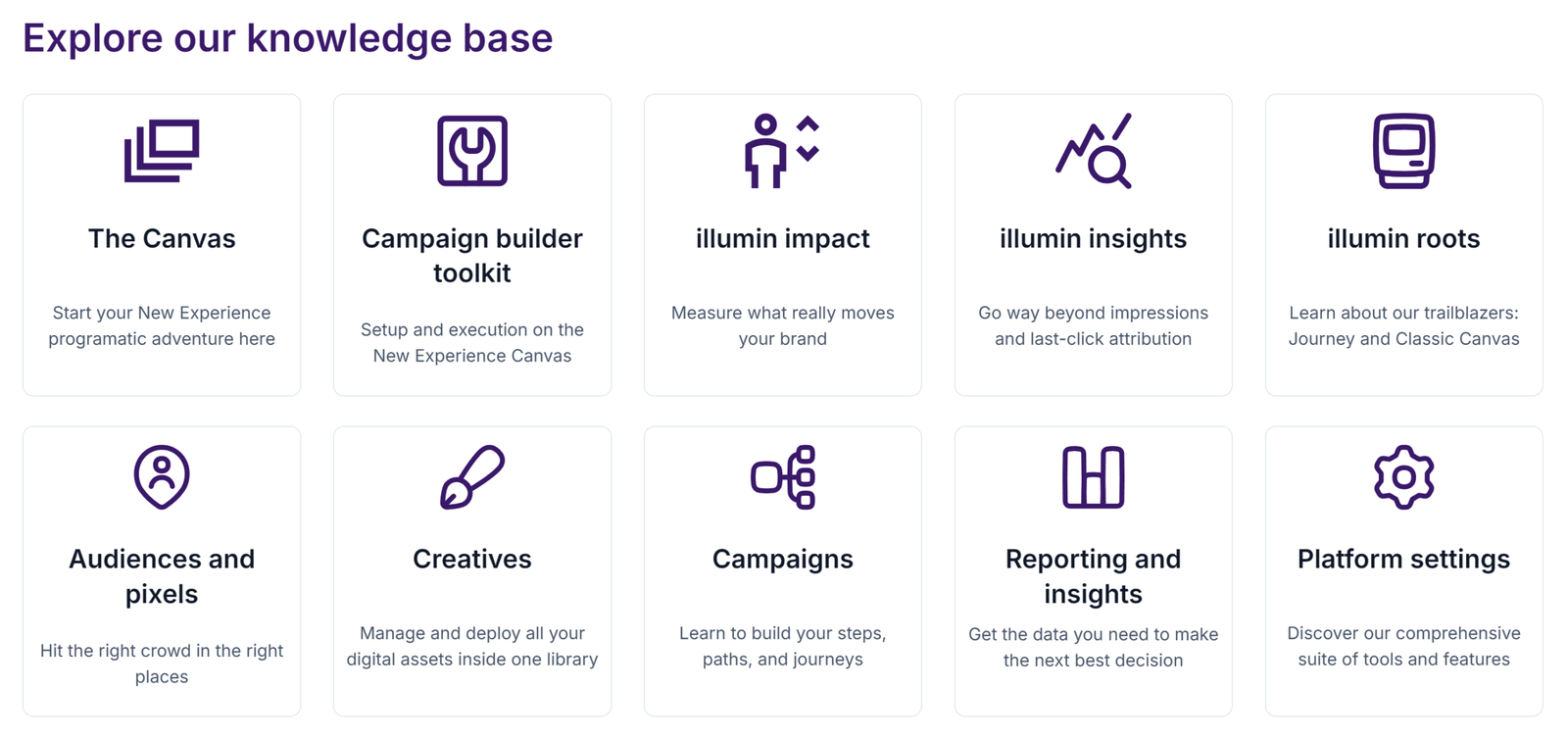
Challenge
illumin faced a triple-cold-start problem:
- Educational gap: No structured pathway existed to move users from novice to certified on the DSP.
- Platform complexity: Two proprietary canvas-based tools lacked any technical documentation.
- Toolchain migration: A move to ServiceNow left the team with a powerful KM engine but zero internal configuration expertise.
Strategic execution
1. ServiceNow knowledge architecture & AI readiness
Acted as the Product Owner for the ServiceNow migration. I configured the taxonomy and metadata structures to ensure search optimization.
- AI integration: Optimized content for Now Assist (AI agent), structuring 100+ articles for high-accuracy retrieval and automated ticket deflection.
- Dive deeper: Read the AI configuration case study.
2. Interactive enablement (Saleo & Camtasia)
Developed 15+ Saleo product tours, overlaying interactive walkthroughs directly on the proprietary UI to reduce time-to-value. I produced video tutorials for high-friction workflows, bridging the gap between static text and UI interaction.
3. Enterprise learning design (Absorb LMS)
Architected the illumin Academy from the ground up, engineering 4 certification courses (31 lessons).
- LMS administration: Managed end-to-end setup on Absorb LMS, from user journey mapping to automated certification triggers.
- Dive deeper: Read the LMS & course design case study.
4. Analytics, content standards & governance
Owned the full KB governance cycle as sole knowledge base administrator, from content standards to usage reporting.
- Monthly analytics: Tracked article performance across 6-month rolling windows, reporting on total views, internal search queries, and the top 15 articles by demand. Used search term data to identify content gaps and prioritise new documentation.
- Content standards: Established editorial guidelines covering structure, tone, terminology, and article lifecycle, ensuring consistency across 100+ articles regardless of contributor.
- Version control: Maintained article versioning discipline within ServiceNow, tracking content changes, review dates, and retirement decisions to keep the knowledge base current and auditable.
- Demand interpretation: Translated usage data into actionable content priorities, identifying that demand clustered around high-risk execution workflows (API integrations, pixel management, inventory configuration) rather than general product education.
Behavioral usage and demand analysis (6-Month snapshot)
Knowledge base engagement
- 6,766 total article views
- 660 internal search queries
- The top 15 articles accounted for 22% of operational demand during the six months.
Demand Concentration
The highest-performing articles were execution-heavy workflow guides:
- Pixel management and implementation (GTM, audience mapping)
- Audience onboarding and LiveRamp integration
- Campaign creation and deal configuration on proprietary canvas tools
- REST API documentation
- Reporting integrations (Looker Studio)
- Holdout experimentation and conversion path analysis
Top search terms further validated transactional intent:
- Deal Configuration
- Guaranteed Inventory
- Tracking Pixel Implementation
- API Integrations
- Data Onboarding Integration
- Impression-Level Controls
Interpretation
User behavior showed that the knowledge base functions as an operational execution system, not a general learning repository.
Demand clustered around high-risk, high-impact workflows:
- Inventory configuration
- API integrations
- Tracking infrastructure
- Experimentation and measurement